Gingival hyperpigmentation is characterized by increased melanin pigmentation of the gingival tissue and is commonly considered an aesthetic concern. Repigmentation can occur after gingival depigmentation procedures. A randomized controlled trial published in Cureus in 2026 evaluated whether topical ascorbic acid 2-glucoside (AS-G), a stabilized vitamin C derivative, could affect clinical outcomes following diode laser gingival depigmentation.
Study Objective
The study evaluated the clinical effects of topical AS-G when used after laser gingival depigmentation, with particular attention to gingival pigmentation recurrence over a nine-month follow-up period.
The researchers compared two treatment groups: diode laser depigmentation alone and diode laser depigmentation followed by topical AS-G application.
Study Design and Participants
This randomized controlled trial was conducted at the Department of Periodontology, Narayana Dental College & Hospital, Nellore, India, between February 2025 and November 2025.
The study included 20 systemically healthy adults aged 18 years or older with physiological gingival melanin pigmentation and an aesthetic concern regarding gingival discoloration. Participants with pathological pigmentation, periodontal disease or gingivitis, tobacco use, previous gingival depigmentation, vitamin C allergy, or conditions that could affect consent or compliance were excluded.
Participants were randomly assigned to two groups, with 10 participants in each group:
Laser depigmentation group: gingival depigmentation using a diode soft-tissue laser.
Laser + AS-G group: the same laser depigmentation procedure followed by topical application of AS-G.
The study was assessor-blinded. Participants and treatment personnel were not blinded because of the nature of the intervention, while the outcome assessor was blinded to group allocation.
Laser Treatment Protocol
Before gingival depigmentation, all participants underwent professional mechanical debridement, including ultrasonic scaling and root planing. Gingival depigmentation was performed two weeks after the initial periodontal therapy.
Both groups were treated using a PIOON diode soft-tissue laser with a wavelength of 980 nm. The reported power settings were 1 W to 1.5 W.
Laser energy was delivered through a 400 μm flexible fiber-optic tip in pulsed contact mode. The pigmented gingival epithelium was removed using gentle, paintbrush-like movements to achieve uniform ablation. Residual tissue debris was removed with sterile gauze soaked in normal saline.
The study also reported the use of protective eyewear for the operator and patient and high-vacuum suction for plume evacuation.
Topical AS-G Treatment
In the test group, topical AS-G gel was applied seven days after the gingival depigmentation procedure.
The formulation contained 10% AS-G (w/v), dissolved in distilled water with propylene glycol and hydroxypropyl methylcellulose as excipients. The formulation was obtained from PerioBiologics LLP in Hyderabad, India.
The gel was stored in individual insulin syringes under refrigerated conditions at 2–8°C and protected from light.
Clinical Assessments
Clinical evaluations were performed at baseline and at one, three, six, and nine months after treatment.
The primary clinical outcome was gingival pigmentation assessed using the Dummett Oral Pigmentation Index (DOPI), a four-point ordinal scale ranging from 0, representing no pigmentation, to 3, representing heavy pigmentation.
Secondary outcomes included:
Plaque Index (PI)
Modified Sulcus Bleeding Index (mSBI)
Patient satisfaction assessed using a Visual Analogue Scale (VAS)
Postoperative pain and discomfort assessed on the seventh day
Study Results
Gingival Pigmentation
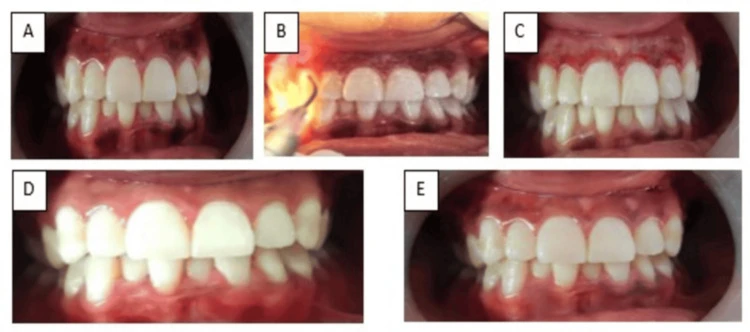
The DOPI results showed no statistically significant difference between the two groups at baseline, one month, three months, or six months.
At the nine-month assessment, a statistically significant difference was observed between the groups (p = 0.004).
At nine months, 8 of 10 participants (80%) in the laser + AS-G group had a DOPI score of 0, while 1 of 10 participants (10%) in the laser-only group had a DOPI score of 0. In the laser-only group, 5 participants (50%) had a DOPI score of 2 at nine months.
Plaque Index
Within both groups, Plaque Index scores showed statistically significant reductions at three, six, and nine months compared with baseline.
When the two groups were compared with each other, there were no statistically significant differences at baseline, one month, three months, or six months. A statistically significant difference was observed at nine months (p = 0.022).
Modified Sulcus Bleeding Index
No statistically significant changes in the modified Sulcus Bleeding Index were observed within the laser + AS-G group during the follow-up period.
In the laser-only group, a statistically significant reduction was observed at nine months compared with baseline.
Between-group comparisons did not show statistically significant differences in modified Sulcus Bleeding Index scores at the evaluated follow-up points.
Patient Satisfaction
Patient satisfaction was assessed at six and nine months using a Visual Analogue Scale.
At six months, there was no statistically significant difference between the groups. The mean satisfaction score was 4.70 ± 0.48 in the laser + AS-G group and 4.50 ± 0.52 in the laser-only group (p = 0.388).
At nine months, the mean satisfaction score was 4.90 ± 0.42 in the laser + AS-G group and 3.60 ± 0.69 in the laser-only group. The difference was statistically significant (p = 0.0001).
Authors' Interpretation
The authors reported that topical AS-G used as an adjunct after diode laser gingival depigmentation was associated with a statistically significant difference in pigmentation recurrence at nine months and higher patient satisfaction at the same follow-up point.
The study authors described AS-G as a potential adjunct to gingival depigmentation procedures and noted that further research with larger sample sizes and longer follow-up periods would be required to validate the findings and determine long-term clinical effects.
Study Limitations
The authors identified several limitations that should be considered when interpreting the study findings.
The study included only 20 participants, with 10 participants in each treatment group.
The study was conducted at a single center, which may limit the generalizability of the findings.
The nine-month follow-up period may not be sufficient to evaluate longer-term gingival pigmentation recurrence.
No histological analysis was performed to assess melanin reduction or cellular changes.
The study relied on clinical measurements, including the DOPI, and patient-reported outcomes.
The DOPI is an ordinal clinical measurement, which may limit the detection of subtle differences between groups.
Multiple statistical comparisons across different follow-up intervals may increase the risk of Type I error.
The authors therefore characterized the findings as preliminary clinical observations and stated that larger studies with longer follow-up and histological assessment would be useful for further validation.
Conclusion of the Study
Within the limitations of this randomized controlled trial, both diode laser gingival depigmentation and diode laser depigmentation combined with topical AS-G were associated with clinical management of gingival hyperpigmentation.
The group receiving topical AS-G demonstrated a statistically significant difference in pigmentation recurrence at nine months compared with the laser-only group, together with higher patient satisfaction at nine months.
The authors concluded that topical AS-G may serve as an adjunct to laser gingival depigmentation and recommended further studies with larger sample sizes, longer follow-up periods, and histological validation.
Study Information
Article: Clinical Efficacy of Topical Ascorbic Acid 2-Glucoside in Enhancing Outcomes of Laser Gingival Depigmentation: A Randomized Controlled Trial
Journal: Cureus
Publication: 2026;18(4):e107127
DOI: 10.7759/cureus.107127
PMCID: PMC13179424
Study type: Randomized controlled trial
Study location: Narayana Dental College & Hospital, Nellore, India
Participants: 20 adults with physiological gingival hyperpigmentation
Follow-up: Nine months
Source
Gudur T, Nagarakanti S, Prudhvi SS, Damai P, Rupavath S, Lebaka S. Clinical Efficacy of Topical Ascorbic Acid 2-Glucoside in Enhancing Outcomes of Laser Gingival Depigmentation: A Randomized Controlled Trial. Cureus. 2026;18(4):e107127. DOI: 10.7759/cureus.107127.