Content type: Clinical Research Review
Publication date: October 15, 2026
Source study: Jomaa K, Abdul-Hak M, Almahdi WH, Al Namly MR, Hanafi L.Efficacy of 810 nm and 650 nm Diode Laser Alone and in Combination With Sodium Fluoride Gel in Treating Dentin Hypersensitivity: A Split-Mouth Randomized Clinical Study. Cureus. 2023;15(1):e33489.
Overview: Key Findings at a Glance
Dentin hypersensitivity is a common clinical concern that can cause short, sharp pain in response to cold, air, tactile stimulation, and other external stimuli. Diode lasers have been investigated as an in-office treatment option, but their clinical effects may vary with wavelength, treatment parameters, and patient characteristics.
A randomized clinical study published in Cureus in 2023 compared 810 nm and 650 nm diode lasers, administered either alone or following the application of sodium fluoride gel. The researchers evaluated pain reduction immediately after treatment and at three, six, and nine months.
Both wavelengths: The researchers reported reductions in dentin hypersensitivity pain following treatment.
Wavelength comparison: The 810 nm group demonstrated greater mean pain reduction than the 650 nm group at all reported assessment points.
Fluoride combination: The study did not detect statistically significant differences in pain reduction between laser-only treatment and laser treatment combined with sodium fluoride gel.
Evidence limitation: Only six patients were enrolled. The findings are clinically interesting but require confirmation in larger, independently conducted trials.
These findings suggest that wavelength selection deserves consideration when evaluating diode laser protocols for dentin hypersensitivity. They do not establish that 810 nm is universally superior for every dental laser application or every patient.
1. Understanding Dentin Hypersensitivity
Dentin hypersensitivity is characterized by brief, sharp pain arising from exposed dentin in response to external stimuli. It should be distinguished from pain caused by other dental conditions, including dental caries, cracked teeth, and pulpal disease.
Exposed dentin may result from gingival recession, periodontal conditions, tooth wear, erosion, abrasion, or other processes that expose dentinal surfaces. The hydrodynamic theory is one widely accepted explanation for dentin hypersensitivity: external stimuli can induce fluid movement within open dentinal tubules, activating sensory nerve endings associated with the dental pulp.
Conventional management may include desensitizing toothpaste, fluoride-containing products, topical agents, and other professionally selected interventions. Laser treatment has also been investigated as an approach to reducing sensitivity.
The choice of treatment should follow an appropriate clinical examination to identify the cause of symptoms and exclude other dental pathology. Laser therapy should not replace diagnosis or necessary treatment of the underlying condition.
2. Original Research: Study Design and Methods
Study objective
The study aimed to compare the clinical effectiveness of 810 nm and 650 nm diode lasers in reducing dentin hypersensitivity, both when used alone and when combined with sodium fluoride gel.
Study population and design
This single-blind, randomized clinical study used a split-mouth design. It included six patients aged 20–30 years with generalized dentin hypersensitivity and evaluated 108 teeth.
810 nm group: Three patients, with 50 teeth included in the final analysis.
650 nm group: Three patients, with 58 teeth included in the final analysis.
Within each wavelength group, teeth were allocated to laser-only treatment or laser treatment following the application of sodium fluoride gel. The final treatment subgroups contained 25 teeth each for the 810 nm laser and 29 teeth each for the 650 nm laser.
Laser treatment parameters
| Parameter | 810 nm diode laser | 650 nm diode laser |
|---|---|---|
| Wavelength | 810 nm | 650 nm |
| Output power | 1 W | 200 mW |
| Operating mode | Continuous wave | Continuous wave |
| Application schedule | Three 30-second applications | Four 30-second applications |
| Total laser application time | 90 seconds | 120 seconds |
| Fiber diameter | 320 μm | 320 μm |
| Application distance | Approximately 2 mm | Approximately 2 mm |
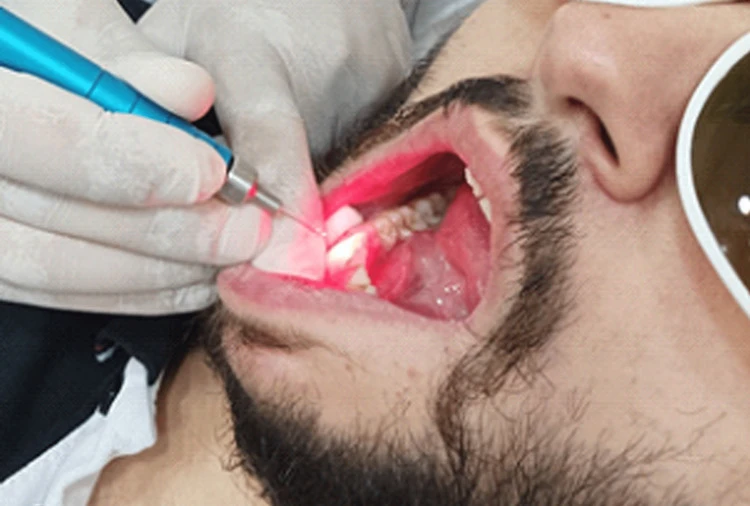
In the combination groups, sodium fluoride gel was applied to the sensitive area for one minute before laser irradiation. Excess gel was removed before laser application. The study used a Pioon multi-wavelength laser device, according to the original article.
Outcome measurement and follow-up
Pain was assessed using a 100-point numeric rating scale, with 0 indicating no pain and 100 indicating very severe, unbearable pain. The researchers applied an air stimulus to the target tooth and recorded the reported pain before treatment, immediately after treatment, and at three, six, and nine months.
The study received approval from the Scientific Research Ethics Committee at the Faculty of Dentistry, Damascus University (approval number UDDS-834-03092019/SRC-1450).
3. Original Research Results
Finding 1: Greater mean pain reduction was reported with the 810 nm laser
The authors reported that the 810 nm diode laser produced greater mean reductions in pain scores than the 650 nm diode laser immediately after treatment and at all three follow-up assessments. This pattern was reported for both laser-only treatment and treatment combined with sodium fluoride gel.
| Assessment point | 810 nm, laser only | 810 nm, with fluoride | 650 nm, laser only | 650 nm, with fluoride |
|---|---|---|---|---|
| Immediately after treatment | 25.2 ± 6.0 | 29.8 ± 4.7 | 7.2 ± 3.1 | 7.5 ± 3.5 |
| 3 months | 26.8 ± 7.1 | 30.6 ± 5.3 | 7.8 ± 3.1 | 8.0 ± 3.4 |
| 6 months | 27.0 ± 6.9 | 30.4 ± 5.8 | 8.8 ± 3.4 | 8.9 ± 3.4 |
| 9 months | 26.8 ± 6.4 | 30.4 ± 4.8 | 9.0 ± 2.8 | 9.6 ± 3.8 |
How to read the table: Values are the mean reductions in pain scores reported in the original study, expressed as mean ± standard deviation. They are not percentages of patients who improved, and they should not be interpreted as percentage reductions in pain.
The original results table reports statistically significant differences between the two wavelength groups at each assessment point. The published table displays the corresponding p-values as 0.00; this is a rounded presentation rather than an exact probability of zero.
Finding 2: Pain reduction was observed throughout the nine-month follow-up
The authors reported lower pain scores after treatment and continued reductions relative to pretreatment assessments during follow-up. The 810 nm group maintained greater mean pain reduction than the 650 nm group through the nine-month assessment period.
This observation is relevant because dentin hypersensitivity treatment is often evaluated not only by its immediate effect but also by whether symptom relief persists. However, a nine-month observation period in six patients does not establish long-term effectiveness across the wider dental population.
Finding 3: Additional benefit from sodium fluoride gel was not statistically established
The researchers found no statistically significant difference in pain reduction between laser-only treatment and laser treatment preceded by sodium fluoride gel within either wavelength group.
Although the mean pain reduction values were numerically higher in the combination subgroups, the study did not demonstrate a statistically significant additional benefit from adding the gel under the conditions tested.
A non-significant result does not prove that the two approaches are equivalent. Larger studies would be needed to determine whether a clinically meaningful difference exists.
4. PIOON Independent Analysis: What Can Clinicians Take Away?
Editorial note: The following section is PIOON's independent interpretation of the reported study design and findings. It is not a statement made by the study authors and should not be regarded as an independent clinical trial or a systematic review.
Wavelength should be considered alongside the full treatment protocol
The study provides a useful clinical comparison of two diode laser wavelengths for dentin hypersensitivity. Nevertheless, the treatment groups differed in more than wavelength: the 810 nm protocol used 1 W for 90 seconds, while the 650 nm protocol used 200 mW for 120 seconds.
Consequently, the observed difference cannot be attributed to wavelength alone. Output power, exposure duration, delivered energy, tissue interaction, and other treatment variables may all contribute to clinical outcomes.
For clinicians evaluating laser protocols, this distinction is important. A wavelength should not be selected solely on the basis of this comparison without considering the intended indication, the device's validated parameters, the clinical diagnosis, and the applicable instructions for use.
Laser-only treatment and combination treatment should not be assumed to be interchangeable
The absence of a statistically significant difference between the study's laser-only and fluoride-combination protocols does not establish that fluoride is unnecessary in routine care. Fluoride products may have other clinical indications, and their use should be determined by the patient's needs and professional judgment.
The study supports a narrower conclusion: under the specific protocols evaluated, an additional reduction in hypersensitivity pain attributable to sodium fluoride gel was not statistically demonstrated.
Clinical outcomes depend on appropriate diagnosis and patient selection
Dentin hypersensitivity is a diagnosis of exclusion. Before choosing a desensitizing intervention, clinicians should assess possible contributing factors and rule out conditions such as caries, cracks, defective restorations, and pulpal disease.
The study enrolled a highly specific population of young adults with generalized hypersensitivity. Its findings should therefore be applied cautiously to older patients, patients with significant systemic conditions, or patients whose symptoms arise from other dental pathologies.
Evidence-based communication is essential
For clinicians, distributors, and dental technology providers, the most defensible message is that the study reported more favorable pain-reduction outcomes with its 810 nm protocol than with its 650 nm protocol. It does not establish a universal ranking of diode laser devices, demonstrate superiority over every conventional desensitizing treatment, or prove that a particular commercial product will reproduce the reported outcomes.
5. Study Limitations and Evidence Quality
Several limitations should be considered before applying these results to clinical practice.
Very small patient sample: The study included only six patients. Although 108 teeth were evaluated, teeth from the same patient are not necessarily statistically independent observations.
Limited generalizability: Participants were aged 20–30 years and met specific inclusion and exclusion criteria. The findings may not represent other age groups or clinical populations.
Different treatment parameters: The two wavelength groups differed in output power and total application time, limiting conclusions about the independent effect of wavelength.
Single-blind design: The article states that patients were blinded, while one researcher performed the clinical procedures. The potential influence of operator-related bias should be considered.
Limited comparator range: The study compared two laser protocols, with and without sodium fluoride gel. It did not establish comparative effectiveness against all conventional desensitizing treatments.
Uncertainty about broader clinical outcomes: The primary assessment focused on stimulus-evoked pain scores. The results do not independently establish improvements in quality of life, patient satisfaction, or other clinical endpoints.
These limitations do not invalidate the study. They define the level of confidence that can reasonably be placed in its findings and identify questions that future research should address.
Larger randomized clinical trials with adequate patient-level sample sizes, standardized treatment parameters, appropriate statistical methods, and longer follow-up would help clarify the comparative effectiveness of different diode laser protocols for dentin hypersensitivity.
6. Clinical Implications for Dental Professionals
This study contributes to the clinical discussion of diode laser treatment for dentin hypersensitivity, particularly the comparison between 810 nm and 650 nm protocols. Its findings may inform further clinical evaluation and research, but they should not be treated as a standalone treatment guideline.
When considering laser-based management, dental professionals should:
Confirm the diagnosis and investigate the cause of dentin exposure and sensitivity.
Select treatment parameters appropriate to the clinical indication and the specific device.
Follow the manufacturer's instructions for use, applicable safety requirements, and relevant laser eye-protection procedures.
Discuss the available treatment options, expected benefits, limitations, and uncertainties with the patient.
Monitor clinical response and reassess persistent or worsening symptoms.
No single wavelength or protocol should be considered universally appropriate for all patients. Treatment decisions remain the responsibility of the qualified dental professional.
7. Frequently Asked Questions
Is an 810 nm diode laser more effective than a 650 nm diode laser for dentin hypersensitivity?
In the 2023 randomized clinical study by Jomaa and colleagues, the 810 nm treatment protocol produced greater mean pain reduction than the 650 nm protocol immediately after treatment and at three, six, and nine months. The study included only six patients, and the treatment protocols differed in power and duration. The results do not establish universal superiority across all devices and clinical settings.
Does adding sodium fluoride gel improve the effect of diode laser treatment?
The study did not detect statistically significant differences in pain reduction between laser-only treatment and laser treatment preceded by sodium fluoride gel. This finding does not prove that the approaches are equivalent or that fluoride has no clinical value in other circumstances.
How long did the clinical study follow patients?
Pain was assessed before treatment, immediately afterward, and at three, six, and nine months. The reported follow-up findings apply to the small study population and do not establish effectiveness beyond the observation period.
Can this study establish that diode lasers are better than conventional desensitizing treatments?
No. The study compared two diode laser wavelengths, with and without sodium fluoride gel. It did not establish superiority over every conventional treatment option.
Can the reported treatment settings be used for every dental laser device?
No. The parameters describe the protocols evaluated in this specific study. They should not be transferred automatically to other devices or indications. Clinicians must follow the relevant device instructions for use and apply their professional judgment.
Conclusion
The 2023 clinical study by Jomaa and colleagues reported greater mean pain reduction with an 810 nm diode laser protocol than with a 650 nm protocol for dentin hypersensitivity, with differences observed immediately after treatment and throughout nine months of follow-up. The addition of sodium fluoride gel did not produce a statistically significant additional benefit under the conditions investigated.
The findings are promising but preliminary because the study involved only six patients and compared protocols with different output powers and treatment durations. Larger, well-designed clinical trials are needed to confirm the results and clarify the contribution of wavelength and other treatment parameters.
For dental professionals, the key message is to interpret laser evidence in the context of study design, patient characteristics, diagnosis, and the complete treatment protocol. Evidence-informed clinical decisions should balance reported outcomes with the limitations of the available research.
Original Research and Further Reading
Jomaa K, Abdul-Hak M, Almahdi WH, Al Namly MR, Hanafi L. Efficacy of 810 nm and 650 nm Diode Laser Alone and in Combination With Sodium Fluoride Gel in Treating Dentin Hypersensitivity: A Split-Mouth Randomized Clinical Study. Cureus. 2023;15(1):e33489.
Read the full text on PubMed Central
View the original publication and DOI
Medical and Editorial Disclaimer
This article is an educational summary of published clinical research and an independent editorial interpretation by PIOON. It is not a clinical practice guideline, a substitute for professional dental judgment, or a guarantee of treatment outcomes. The original study's findings and limitations remain those reported by its authors. The independent analysis is not an additional clinical study and should not be interpreted as proof of product-specific effectiveness.
Laser devices must be used by appropriately trained professionals in accordance with their intended indications, applicable regulations, safety requirements, and manufacturer instructions for use.