
Orthodontic treatment commonly involves temporary pain or discomfort, particularly following procedures that apply mechanical forces to the teeth. A randomized controlled trial published in BMC Oral Health in 2024 evaluated whether low-level laser therapy (LLLT) and low-intensity pulsed ultrasound (LIPUS) could reduce pain following orthodontic separation.
Study Overview
The study, titled “The effectiveness of low-level laser therapy and low-intensity pulsed ultrasound in reducing pain induced by orthodontic separation: a randomized controlled trial,” was conducted by Lama Mohammad Saffouh Al-Hanbali, Ahmad Sharafeddin Burhan, Mohammad Younis Hajeer, and Fehmieh Rafik Nawaya.
The trial was designed as a single-blinded, three-arm randomized controlled clinical study. It compared the effects of LLLT, LIPUS, and no additional intervention on pain associated with orthodontic separation.
The study was conducted at the Department of Orthodontics, Damascus University, with patients recruited between August 2022 and February 2023. The trial was registered with the German Clinical Trials Register as DRKS00029991.
Study Participants
A total of 150 patients were initially assigned to three groups, with 50 participants allocated to each group. After losses and exclusions during follow-up, 145 patients were included in the final analysis. The participants were 70 males and 75 females aged 18 to 25 years.
Participants had complete eruption of the four first permanent molars and specific posterior interproximal contact requirements. Patients with previous orthodontic treatment, severely rotated first or second molars, metabolic or periodontal diseases, or relevant medication use were excluded.
Clinical Interventions
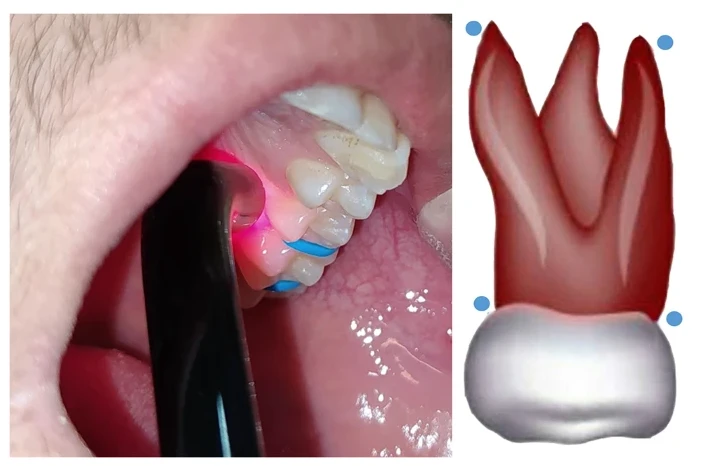
Orthodontic separation was performed using 2.1 mm elastomeric separators. Five minutes after separator placement, participants in the LLLT group received low-level laser therapy on the maxillary and mandibular first molars.
The laser intervention used a soft-tissue diode laser, Mercury-Dual (Pioon Medical Laser, China), with an 810 nm aluminum-gallium-arsenide diode laser operating in continuous mode.
Wavelength: 810 nm
Output power: 150 mW
Energy density: 4 J/cm2
Spot diameter: 7 mm
Exposure time: 20 seconds at each treatment point
Application sites: eight buccal and lingual mucosal points around the first molars
Application schedule: immediately after separation, and repeated after 24 and 48 hours
The LIPUS group received treatment using an ultrasonic toothbrush operating at 1.6 MHz with an average output intensity of 0.2 W/cm2. The application lasted 20 minutes per treatment session and was repeated after 24 and 48 hours.
The control group received the orthodontic separators without an additional intervention.
Pain Assessment
Pain intensity was evaluated using a 100 mm Visual Analog Scale (VAS). Assessments were performed at 5 minutes, 1 hour, 6 hours, 12 hours, 24 hours, 48 hours, 72 hours, and 96 hours after separator placement.
The study therefore evaluated pain during the first four days following orthodontic separation, including the period when pain was reported to reach its highest level.
Study Findings
The study reported a statistically significant difference in pain perception among the three groups after 5 minutes (P = .002).
The maximum pain level was observed at 24 hours after separator placement in all three groups. At this time point, the reported mean pain score was 12.70 ± 9.50 in the LLLT group, 11.35 ± 9.60 in the LIPUS group, and 57.91 ± 27.20 in the control group.
According to the study, both the LLLT and LIPUS groups showed statistically significantly lower pain scores than the control group at the assessed time points (P < .001).
The study did not identify a statistically significant difference between the LLLT and LIPUS groups in their ability to reduce orthodontic separation pain (P > .05).
Pain scores decreased in all three groups from the second through the fourth day following separator placement.
Comparison of LLLT and LIPUS
The trial directly compared two non-pharmacological approaches for orthodontic separation pain: low-level laser therapy and low-intensity pulsed ultrasound.
Both interventions were associated with significantly lower pain scores than the untreated control group. However, the study found no statistically significant difference between LLLT and LIPUS in pain reduction.
Based on the reported findings, the authors concluded that multiple applications of both LLLT and LIPUS were effective in reducing pain induced by orthodontic separation, with no difference between the two interventions in separation pain control.
Study Limitations
The authors noted that the generalizability of the findings is limited because pain is a personal experience and may not be measured identically by all participants.
The study also required patients receiving LLLT to attend the clinical setting for applications on three consecutive days. The authors noted that this repeated attendance could be inconvenient for some participants.
The study compared a specific LLLT protocol and a specific LIPUS protocol in a defined group of orthodontic patients. The findings therefore relate to the intervention conditions evaluated in this trial.
Conclusion
In this randomized controlled trial, multiple applications of low-level laser therapy and low-intensity pulsed ultrasound were associated with reduced pain following orthodontic separator placement compared with the control group.
The study found no statistically significant difference between LLLT and LIPUS in reducing orthodontic separation pain. Pain reached its highest reported level at approximately 24 hours after separator placement and subsequently decreased over the following days.
Reference
Al-Hanbali LMS, Burhan AS, Hajeer MY, Nawaya FR. The effectiveness of low-level laser therapy and low-intensity pulsed ultrasound in reducing pain induced by orthodontic separation: a randomized controlled trial. BMC Oral Health. 2024;24:166. doi:10.1186/s12903-024-03926-2.
Original article: https://doi.org/10.1186/s12903-024-03926-2
Clinical trial registration: DRKS00029991, German Clinical Trials Register.