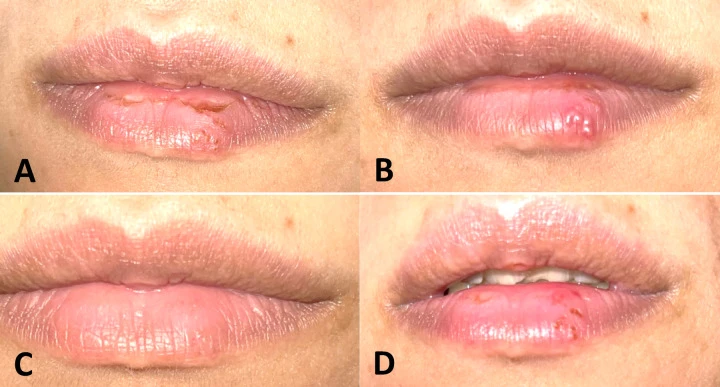
This article summarizes a randomized controlled trial that compared antimicrobial photodynamic therapy (aPDT) combined with photobiomodulation therapy (PBMT) against acyclovir cream and PBMT alone for the management of active recurrent herpes labialis (RHL, cold sores). The study enrolled 60 participants across three treatment arms and measured pain (visual analog scale) and lesion healing time over a 7-day follow-up. The authors reported that combined aPDT and PBMT reduced pain more rapidly and shortened healing time relative to acyclovir, with no long-term recurrence data collected.
Introduction
Recurrent herpes labialis (RHL) is a common, recurrent viral lesion caused by herpes simplex virus type 1, characterized by painful vesicular eruptions on the lips that typically heal within 7–10 days. Standard management relies on antiviral agents such as topical acyclovir, which can reduce symptoms but does not prevent recurrence. Antimicrobial photodynamic therapy (aPDT) and photobiomodulation therapy (PBMT) have been explored as adjunctive or alternative physical approaches to accelerate healing and relieve pain. This study was designed to evaluate whether combined aPDT and PBMT offers clinical benefits over conventional acyclovir cream and over PBMT alone in adults with active RHL lesions.
Study Overview
The study was a double-blinded, randomized, parallel-group, active-controlled trial with three treatment arms. It was conducted at the Department of Oral Medicine, Faculty of Dentistry, Damascus University, Syria, and ran from June 2024 to January 2025. Of 73 screened individuals, 60 eligible participants were randomly allocated to three groups (n = 20 per group). The trial was registered in the ISRCTN registry (ISRCTN10142572) on 20 January 2025, and approved by the Ethics Committee of Damascus University (N2183).
Eligible participants were healthy adults older than 18 years with a history of RHL and a current active vesicular lesion. Exclusion criteria included smoking, pregnancy or lactation, diabetes, immunosuppression, allergy to study agents, skin conditions affecting healing, antiviral use within 4 weeks, and anti-inflammatory or antibiotic use within 2 weeks. The study followed the CONSORT guidelines and the Declaration of Helsinki. Sample size was calculated using G*Power 3.1.9.4 (effect size f = 0.41, power 80%, α = 0.05).
Materials and Methods
Participants were assigned to one of three groups:
Group 1 (control): 5% acyclovir cream (Veramed, Medico Labs., Damascus, Syria) applied five times daily for 5 days, plus a non-activating (sham) laser for blinding.
Group 2 (PBMT): PBMT applied with a low-level laser therapy device, plus a placebo cream five times daily.
Group 3 (aPDT + PBMT): lesions were cleaned with saline, de-roofed with a sterile needle for drainage, and dried; 0.01% methylene blue photosensitizer (Citrate Methylene Blue, 0.01% w/v, White Labs., California, US) was applied for 5 minutes, followed by laser irradiation; residual photosensitizer was wiped with saline. A second PBMT session without photosensitizer was performed 48 hours later. A placebo cream was applied five times daily.
PBMT (LLLT) parameters
| Parameter | Value |
|---|---|
| Wavelength | 650 nm |
| Power | 100 mW (0.1 W) |
| Beam spot size at target | 2.54 cm² |
| Power density | 40 mW/cm² |
| Application mode | Continuous wave |
| Application technique | Contact |
| Exposure duration | 120 s per spot |
| Radiant energy | 12 J per spot |
| Radiant exposure (fluence) | 4.7 J/cm² |
| Sessions | Two, 48 h apart |
aPDT session parameters
| Parameter | Value |
|---|---|
| Photosensitizer | Methylene blue, 0.01% |
| Wavelength | 650 nm |
| Power | 100 mW (0.1 W) |
| Beam spot size | 0.5 cm² |
| Power density | 200 mW/cm² |
| Mode / technique | Continuous wave / contact |
| Exposure | 120 s per spot |
| Radiant energy | 12 J per spot |
| Radiant exposure | 24 J/cm² |
| Sessions | Single |
Outcome measures
Pain intensity was assessed with a 10-point visual analog scale (VAS, 0–10), where 0 = no pain and 10 = extreme pain, at five time points: t0 (baseline), t1 (after the first laser session), t2 (48 h later, before the second session), t3 (after the second laser session), and t4 (7-day follow-up). Lesion healing was defined as spontaneous detachment of the crust and recorded in days. Two blinded assessors performed evaluations (intraclass correlation coefficient > 0.8).
Statistical analysis was performed using IBM SPSS Statistics 24. The Kolmogorov–Smirnov test assessed normality, and the Kruskal–Wallis test compared groups, with significance set at p < 0.05.
Main Study Results
Demographic characteristics were balanced across groups. Of 60 participants, 52 (86.67%) were female and 8 (13.33%) were male, with a mean age of 25.50 ± 7.19 years (range 19–50).
Pain scores (VAS)
The table below reports mean ± SD (minimum–maximum) VAS scores at each time point and the between-group Kruskal–Wallis p value.
| Time point | Control (n = 20) | PBMT (n = 20) | aPDT + PBMT (n = 20) | Kruskal–Wallis p |
|---|---|---|---|---|
| t0 (baseline) | 4.20 ± 2.17 (1–8) | 4.70 ± 2.54 (1–8) | 4.35 ± 2.30 (1–10) | 0.838 |
| t1 (after first session) | 3.85 ± 2.48 (0–8) | 2.45 ± 2.24 (0–7) | 1.60 ± 1.79 (0–5) | 0.013 |
| t2 (48 h, before second) | 1.50 ± 1.57 (0–5) | 0.85 ± 1.66 (0–6) | 0.55 ± 1.32 (0–5) | 0.038 |
| t3 (after second session) | 1.40 ± 1.47 (0–4) | 0.45 ± 1.00 (0–3) | 0.25 ± 0.72 (0–3) | 0.003 |
| t4 (7-day follow-up) | 0.00 ± 0.00 | 0.00 ± 0.00 | 0.00 ± 0.00 | 1.000 |
Pain scores did not differ significantly at baseline (p = 0.838). From t1 onward, the between-group differences were statistically significant (t1 p = 0.013; t2 p = 0.038; t3 p = 0.003), driven mainly by lower scores in the aPDT + PBMT group. Pairwise comparisons indicated that the aPDT + PBMT group had significantly lower pain than the control group at t1 (p = 0.011), t2 (p = 0.041), and t3 (p = 0.005), and significantly lower pain than the PBMT group at t3 (p = 0.020). Differences between the control and PBMT groups were not statistically significant at any time point (all p > 0.05). By t4, all groups reached a VAS score of 0.
Healing time
| Group | Mean healing time (days) | Range (days) |
|---|---|---|
| Control (acyclovir) | 4.75 ± 1.25 | 3–8 |
| PBMT | 4.05 ± 1.32 | 2–6 |
| aPDT + PBMT | 3.20 ± 1.06 | 2–6 |
The between-group difference in healing time was statistically significant (p = 0.001). Pairwise comparison showed the aPDT + PBMT group healed significantly faster than the control group (p = 0.001); the difference between aPDT + PBMT and PBMT alone was not statistically significant (p = 0.090), and healing time did not differ significantly between control and PBMT (p = 0.413).
Study Conclusion
The authors concluded that combined aPDT and PBMT is a promising approach for managing RHL and that it outperformed conventional acyclovir cream as well as PBMT alone in relieving symptoms and accelerating recovery, based on faster pain reduction and shorter healing time observed in this trial. These findings are limited to the short-term management of active lesions in the studied sample and should not be interpreted as evidence of cure, viral clearance, or recurrence prevention, because the study did not include long-term follow-up or recurrence monitoring.
The authors identified the main limitation as the insufficient follow-up period to assess the effect of treatment on relapse. Additional limitations noted include the absence of a PBMT-free aPDT-only arm, no repeated irradiation, a short follow-up window, and no assessment of patient satisfaction, quality of life, or adverse effects. The sample was predominantly female (86.67%), which may limit generalizability.
Original Research Reference
Al-Hallak MAG, Karkoutly M, Hsaian JA, Aljoujou AA. Effect of combined antimicrobial photodynamic therapy and photobiomodulation therapy in the management of recurrent herpes labialis: a randomized controlled trial. Scientific Reports. 2025;15:01331. Published 9 May 2025. DOI: 10.1038/s41598-025-01331-5. PMCID: PMC12064730. PMID: 40346266. Trial registration: ISRCTN10142572.