You are comparing two soft-tissue diode lasers. The same absorption chart keeps coming up. This article answers a different question: which laser fits the work you actually do?
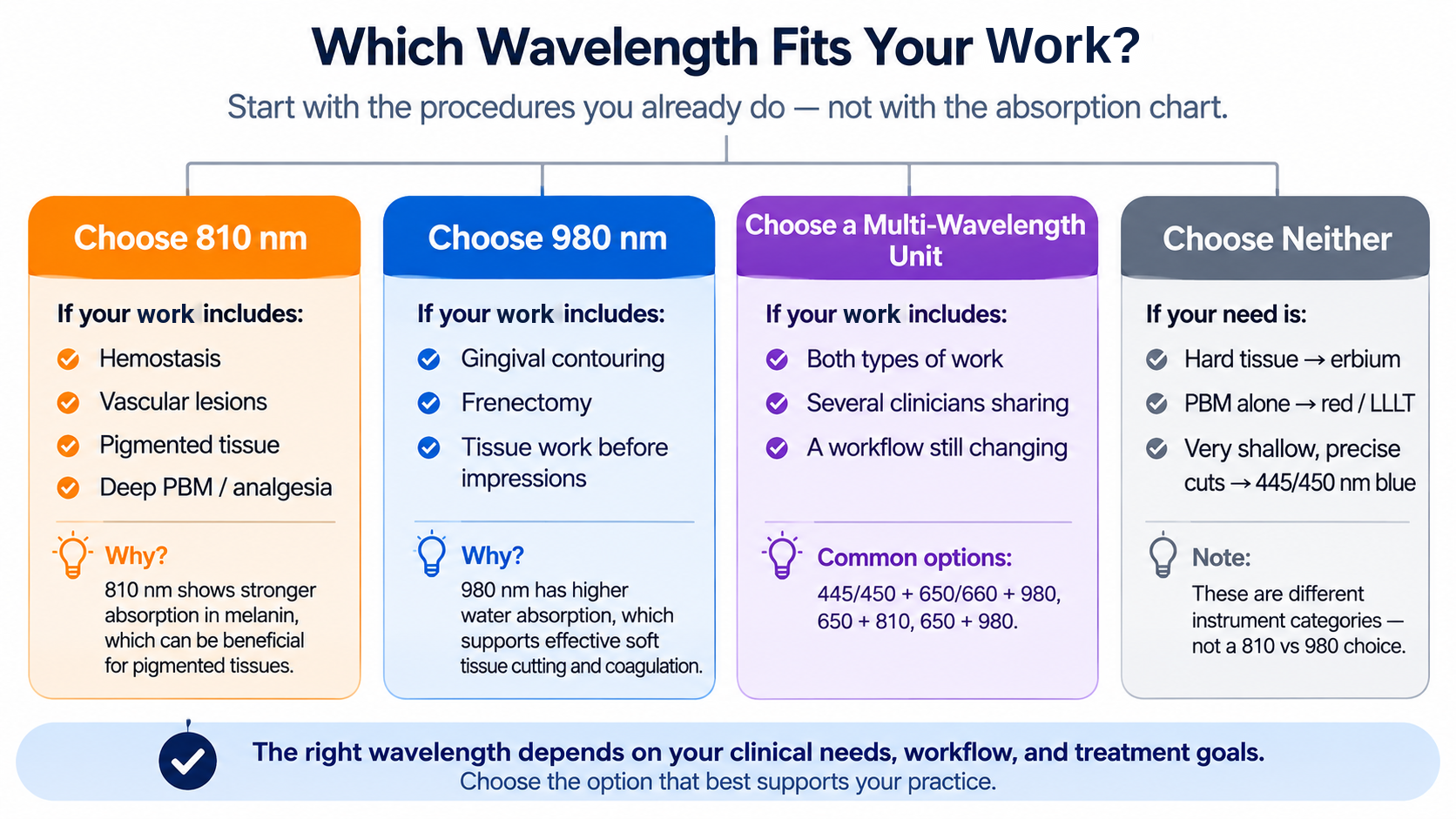
The short answer: 810 nm vs 980 nm by case mix
Here is the short answer. The reasoning comes later.
· Choose 810 nm if your day is mostly hemostasis (stopping bleeding), vascular or pigmented lesions, or deeper photobiomodulation (PBM, also called low-level laser therapy).
· Choose 980 nm if your work is mostly superficial ablation of well-hydrated tissue — gingival contouring, frenectomy, or tissue work before impressions. A water absorption peak near 970 nm keeps energy near the surface [5]. Independent studies also show that irrigation reduces carbonization (charred tissue at the cut edge) and necrosis (dead tissue) while keeping cutting ability [7,8]. This is a valid workflow choice, provided your unit supports irrigation and the presets are tuned for it.
· Choose a multi-wavelength system if you do both types of work, if several clinicians share the unit, or if your laser workflow is still changing. In those cases, forcing a single-wavelength answer is usually a mistake.
· Choose neither if your real need is hard tissue, PBM alone, or very shallow non-contact work. Those belong to different instrument categories.
What wavelength changes — and what it doesn't
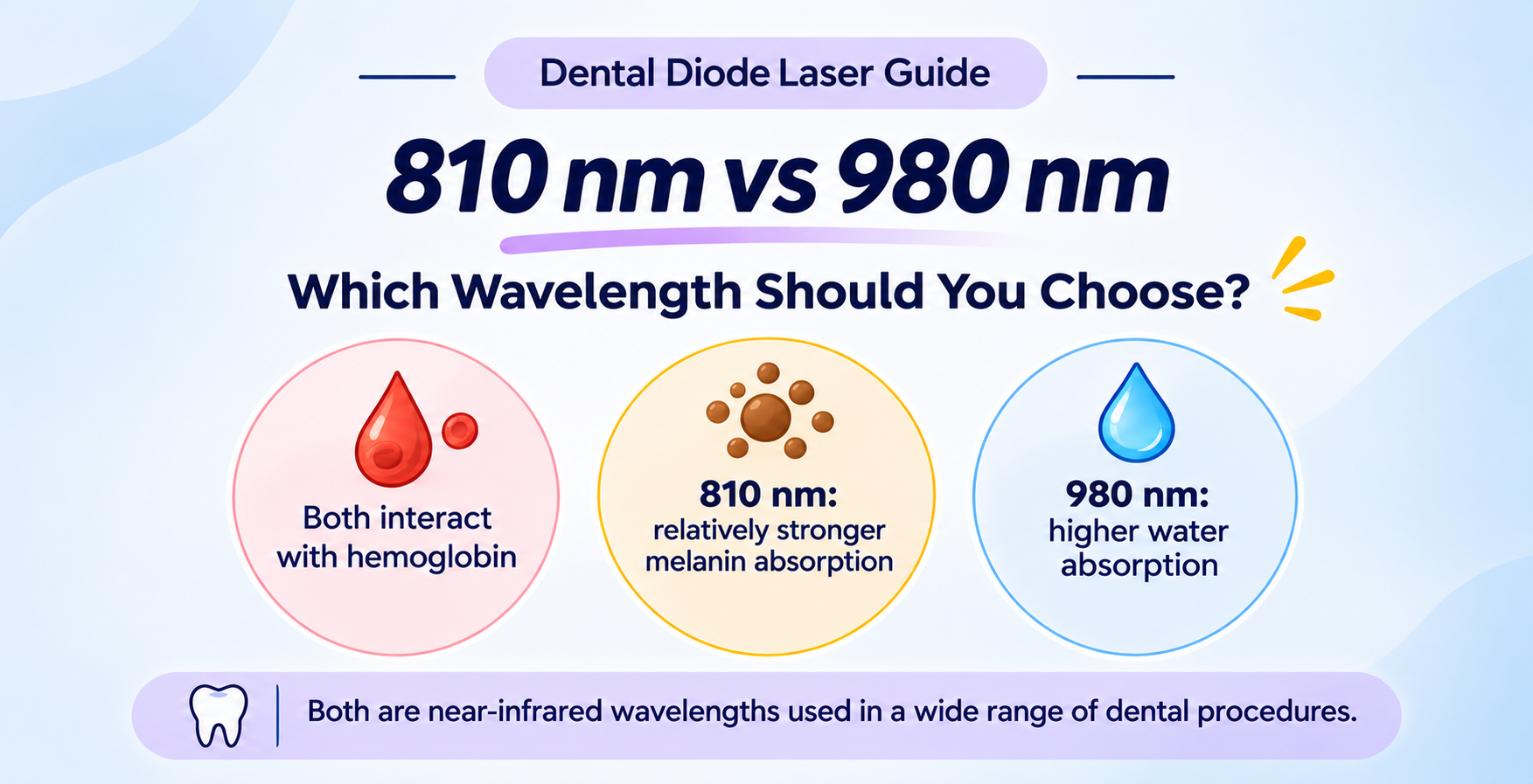
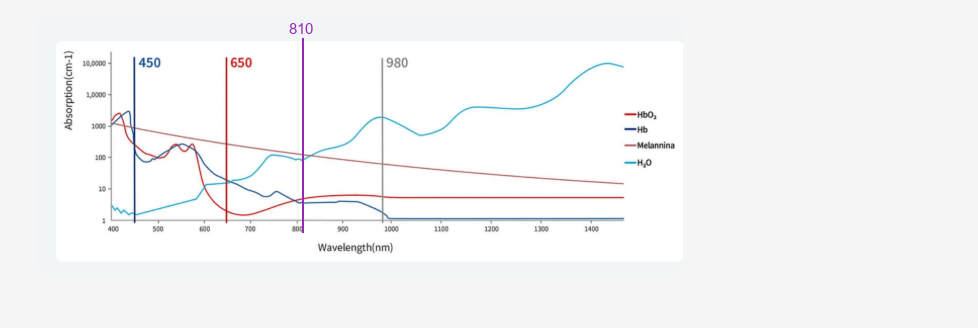
The physics is real. Light around 810 nm is absorbed mainly by hemoglobin and melanin, with little absorption in water. It penetrates further into soft tissue. Light around 980 nm sits on a local water absorption peak, while still being absorbed by hemoglobin. More of its energy stays near the surface. These are genuine differences, and you can feel them in your hand [5].
But the physics does not prove that one wavelength is clinically better. That step skips several variables that matter more at the chairside.
Look at the regulatory record. In October 1998, the FDA cleared the CeramOptec Ceralas D15, a 980 ± 30 nm diode. Its predicate (the already-cleared device used for comparison) was an 805–820 nm diode dental laser. The 510(k) summary was written by the applicant and submitted to the FDA. It states that the main technological difference was wavelength. It also states that this difference was not believed to raise new questions of safety and effectiveness. Under "Performance Data", it reads: None required [1]. No comparative clinical data were submitted, because none were asked for.
A 510(k) clearance means substantial equivalence to an existing device. It is not a judgement of superiority. Here, the 980 nm device was compared to an 810 nm-era device. So 980 nm was never established as a newer or better generation, and 810 nm was never established as a lesser one.
Look at the tissue. In a blinded histological study, 14 rabbits received standardized incisions on the tongue with 810, 940 and 980 nm diodes. All used continuous mode, the same protocol, and the same operator. Incision depth (p = 0.121), width (p = 0.376), carbonization zone (p = 0.692) and necrotic zone (p = 0.223) showed no statistically significant differences. All sites healed completely by 14 days [2].
Look at clinical experience. One dentist with 25 years of soft-tissue diode use, writing on a manufacturer's website, said the two wavelengths were almost impossible to tell apart in use. His advice was to focus on fiber-tip initiation, power settings and technique rather than wavelength. This is one clinician's impression, not evidence. But it agrees with the controlled comparisons above.
Look at the review literature. A systematic review of nine randomised trials on peri-implant inflammation found that all wavelengths and applications gave similar results. It warned that comparing different wavelengths under one general label of "laser treatment" is not scientifically sound [6]. In super-pulsed systems, peak power, pulse width, and duty cycle (how long the laser is on in each cycle) affect heat spread far more than a 170 nm shift does.
None of this means the two wavelengths behave the same way at the chairside. It means wavelength is a workflow variable, not a quality ranking. Both are cleared, well-studied soft-tissue instruments. They differ in where energy is deposited, what you can pair them with, and how you manage heat. Choose the one whose workflow fits your work.
Why this decision still feels so hard
If wavelength is only a workflow variable, why does the choice feel so important? Because the real difficulty is practical, not optical.
Your case mix is mixed. A comparison table assumes you do one kind of procedure. In reality, a general practice might contour a crown margin, uncover an implant, treat an aphthous ulcer, and run a low-level pain protocol in the same week. No single wavelength suits all of them. The table gives you no way to weigh one procedure against another.
You are buying a system, not a beam. Power stability, whether the fiber tip needs initiating, fiber diameter, pulse control, preset protocols, and the cost of disposable tips all vary within one wavelength. These can vary more than they do between wavelengths. An "810 vs 980" comparison that pairs a 3 W unit with a 10 W unit is mainly comparing power, not absorption.
The laser stays with you longer than your current case mix. A diode laser is typically a five-to-eight-year purchase. You may start placing implants, adopt intraoral scanning, or delegate more work to hygienists. The requirement you are optimizing for today will change.
Most sources have a commercial interest. This is the most frustrating part, so it is worth naming. Manufacturer and trade sources quote absorption ratios that disagree with each other. Both are used to argue for 980 nm. Independent spectroscopy does confirm the physics: there is a water absorption peak near 970 nm, and both 810 and 980 nm sit inside the 650–1350 nm optical window where tissue absorption is low. This is precisely why near-infrared diodes need a hot tip to cut at all [5]. But an absorption ratio describes light in water. It does not describe outcomes in a patient.
The same caution works in the other direction. One trial reporting higher temperature or pain with one wavelength tells you about that protocol, not about the wavelength in general. Neither a brochure ratio nor a single study can tell you how a unit will behave with your settings. That is why the rest of this article is organized around procedures and delivery.
Implants are a good example, because the literature points in more than one direction. Laboratory measurements of temperature at the titanium surface and clinical measurements of gingival temperature and pain are not the same thing. One 2024 randomised trial of 24 implants found higher gingival temperature and higher 24-hour pain with 980 nm during second-stage uncovering [3]. That is a useful safety signal for that procedure and those settings. Its endpoints were tissue temperature and short-term pain, not incision quality, healing, or long-term outcomes. Irrigation and pulse settings were not the variables under study. Independent systematic reviews, meanwhile, report similar results across wavelengths and caution against pooling them [6].
So the practical answer is not "810 nm is safer." Set power, pulse, tip state, and cooling deliberately. Then check what your own Instructions for Use say about working around implants.
A decision process you can actually run
Here is a five-step sequence instead of another comparison table.
1. List the three procedures you perform most often. Use the last three months of your schedule, not the procedures you hope to add. This one step settles more decisions than any absorption coefficient.
2. For each procedure, name the tissue problem — not the procedure name. Is the challenge bleeding, pigmented tissue, hydrated tissue that needs vaporization, deep analgesia, or bacterial load? Bleeding and pigmentation point toward hemoglobin and melanin absorption. Hydrated superficial ablation points toward water absorption, and toward checking whether the unit supports irrigation. Deep PBM points toward the near-infrared window where 810 nm sits. Now you are matching mechanisms, not marketing categories.
3. Check the Instructions for Use (IFU), not the website. Is the exact model cleared or registered for those indications in your market? Ask for the indications list. A wavelength may be theoretically ideal for a procedure that the device in front of you is not cleared for.
4. Compare the delivery system, not the wavelength. Near-infrared diodes in this range are weakly absorbed by soft tissue. With either wavelength, routine contact cutting relies largely on a hot, initiated fiber tip. Initiation means carbonizing the tip so it cuts by heat conduction. The beam alone does not vaporize tissue efficiently.
In an ex vivo study (tissue outside the body) of 96 bovine-tongue incisions, incision quality was better with initiated tips at both 810 and 980 nm. Non-initiated tips gave poorer incisions and greater temperature rise. Pulsed 810 nm produced the smallest temperature change [4]. Systematic reviews also warn that grouping different wavelengths under one label of "laser treatment" is not scientifically sound [6].
Initiation is therefore a technique choice linked to the procedure. It is not a property that separates the two wavelengths. That does not make them interchangeable in use. Where the energy is deposited, and whether your unit can irrigate, still change the cut and the heat. Those are workflow differences worth paying for, even if they are not differences in outcome.
Ask these questions: What do tips cost per procedure? Are they single-use? Who trains your team? How often must the tip be re-initiated during a case? Is the quoted power average or peak, and at what duty cycle?
5. Ask what happens when your case mix changes. Can a second wavelength be added as a module, or do you need a new unit? Are the presets validated, and what evidence supports them? If the answers leave you choosing between two similar systems, then accept it: wavelength is not your deciding factor. Buy on indications, delivery, control and support.
One note for US practices: CDT codes (the US dental procedure code system) generally reimburse the procedure, not the device. Laser use is typically not separately billable. Your return on this purchase comes from the number of indicated, billable procedures your team will actually perform. It does not come from the number of nanometers the unit emits.
When 810 nm is the better call
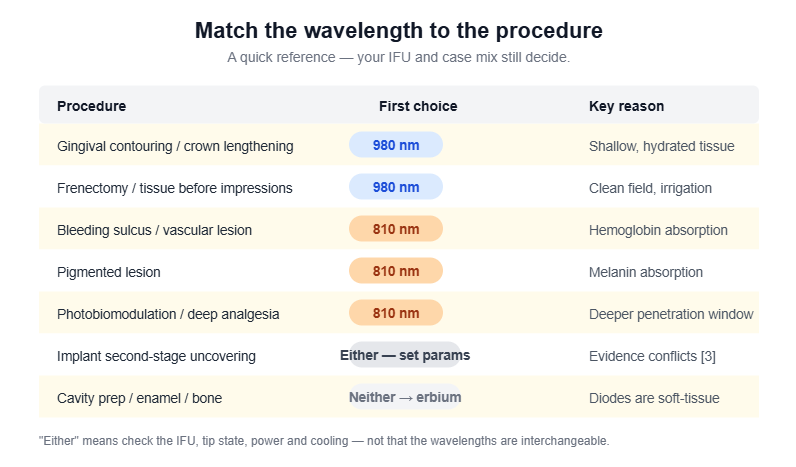
Choose 810 nm when hemostasis is a recurring problem. It also fits regular treatment of vascular or pigmented lesions, and practices where PBM, deep analgesia and healing support are a meaningful part of the offering. Its weaker water absorption means deeper penetration. That is a drawback for superficial ablation, but an advantage when the target is deeper or pigment-based.
Two points to check before you commit.
First, 810 nm is absorbed by melanin as well as hemoglobin. Heavily pigmented tissue therefore takes up more energy near the surface. Check the specific IFU for settings guidance instead of assuming a default power.
Second, deeper penetration is a real advantage for PBM and for pigmented or vascular targets. It also means more energy travels beyond the surface, so pulse control and hand speed still matter. Neither point makes 810 nm safer or better overall. Both are reasons to match it to the right indications and the right parameters.
When 980 nm is the better call
If you recognized your own schedule in the opening section, this part is for you. Your work is mostly shallow, well-hydrated soft tissue, often in the same visit as an impression or prosthetic fitting. 980 nm is a reasonable choice, and there is independent evidence for this preference.
Independent tissue-optics data place a water absorption peak near 970 nm. So 980 nm deposits more energy near the surface than 810 nm does [5]. That surface-limited deposition works well with irrigation.
In an in vitro study (in a laboratory) of 36 porcine-liver incisions, adding water/air cooling to a micropulsed 980 nm diode increased incision depth significantly without widening the incision. At the right cooling setting, the total damage area was smaller, while irreversible damage stayed about the same [7]. A histomorphometric study of 24 goat gingiva samples found that saline irrigation with a super-short-pulse 980 nm diode reduced carbonization and necrosis without losing cutting ability [8].
Both are laboratory tissue studies, not clinical trials. Both state their own limits: species differences, sample size, and the need for standardized irrigation systems. Together, they give a coherent physical account of the workflow clinicians are buying. That means controlled superficial cutting with convective cooling, a clear field, and less carbonization and necrosis at the margins — without losing the ability to cut.
The evidence does not support a claim of better healing or fewer complications with 980 nm. A blinded comparison of 810, 940 and 980 nm found no significant difference in incision depth, width, carbonization or necrosis [2]. An ex vivo study of 96 bovine-tongue incisions found better incision quality with initiated tips at both wavelengths [4]. A systematic review of randomised trials found similar outcomes across wavelengths and applications [6]. Claims about pulpal heating are also unsettled: ex vivo measurements change with power, exposure time and the presence of bleaching gel. The "radiant versus conductive energy" framing and the widely quoted absorption ratios come from manufacturer and trade material, not comparative outcome studies.
The fair summary: the case for 980 nm is a workflow case — surface-limited ablation with irrigation. It is a good case if that is your work. It is not a claim of better healing or less pain. Buy it for the workflow, then verify that the unit can deliver it: irrigation, pulse control, tips and presets.
When neither wavelength is the answer
Four situations fall outside a two-way comparison.
You need both absorption profiles. Here the market is narrower than the physics. A true 810 + 980 nm pair is uncommon among established dental brands. The Gemini line is the best-known example. Standalone units from regional and OEM manufacturers exist, but they are not mainstream choices in mature markets. A more common layout uses a blue cutting wavelength, a red PBM wavelength, and one infrared channel — 445/450 + 660/650 + 980, or the same pattern built on 810. Two-channel 650 + 810 and 650 + 980 systems are also widespread. If that matches your work, compare those platforms. Do not assume an 810/980 pair is the standard dual-wavelength option.
You need hard tissue. Diodes in this range are soft-tissue instruments. Cavity preparation, enamel and bone work belong to erbium wavelengths or 9.3 µm CO₂ systems. No choice between 810 and 980 changes that.
You need PBM specifically. Then a surgical diode platform is not the obvious starting point. In dental PBM the practical split is by depth. Red 650/660 nm acts more superficially, on mucosal healing and early analgesia. Near-infrared 810 nm penetrates further, toward submucosal and periosteal targets. Head-to-head trials are small and give neither wavelength a general win. Reported advantages differ by endpoint: 810 nm for radiographic bone measures, 650 nm for histological markers and early analgesic use. A dedicated low-level unit, or the red channel of a multi-wavelength platform, is the usual answer. The 445/450 nm blue channel is for cutting, not PBM.
You need minimal heat spread in very shallow work. A 445/450 nm blue diode is the more relevant comparison. It absorbs strongly in hemoglobin and melanin, so it can cut without contact and without an initiated tip. That is a different mechanism from either near-infrared wavelength.
Five questions to put to any supplier
Is this exact model cleared or registered for the procedures I plan to perform in my market? Please send the IFU indications list.
Is the stated output average or peak power? At what pulse width and duty cycle?
Does this protocol require an initiated fiber tip? What is the cost per procedure, and does it include training?
Does the unit support irrigation for the protocols I use? What evidence supports the preset parameters?
If I add a second wavelength or change my case mix in two years, is that a module or a new unit?
The answers will shape your clinical results and your costs more than the difference between 810 and 980 nm. A brochure will not give them to you.
The bottom line
Choose based on your case mix, not on an absorption chart.
Mostly shallow ablation in hydrated tissue: a 980 nm system with good irrigation and pulse control is a sound choice.
Mostly hemostasis, pigmented or vascular lesions, and deep PBM: 810 nm is the better fit.
Purely PBM: start with a red or dedicated low-level device.
Mixed surgery: compare the blue/red/infrared platforms actually on the market. Do not assume an 810/980 pair is the default.
In every case, confirm the IFU indications, the delivery system and the pulse control. Ask the supplier for the parameters behind any performance claim: power, pulse width, tip state, and whether cooling was used. Those numbers describe what will actually happen in your hand.
Wavelength is worth getting right. It does not need to dominate your decision.
If you would like an unbiased comparison built around your procedure list—indications, fiber and tip options, training requirements, and what a second wavelength would add—send us your case mix. Our clinical team will walk through the configurations with you.
A note on sources and interests
We make diode lasers, including 980 nm systems. So read this critically. Here is what our claims rest on:
Independent evidence. Every clinical conclusion comes from peer-reviewed studies or one FDA document. No brochures.
Both directions. We cited studies for and against a water-cooled 980 nm workflow. If one trial points against a wavelength, we say what it measured — and what it did not.
The FDA document. A 510(k) summary is written by the manufacturer, not the FDA. It shows clearance, not superiority.
Manufacturer claims. Quoted absorption ratios appear only to show where the claims come from and why they disagree. They are not proof of performance.
Product names show what exists, not what is best.
References
[1] U.S. Food and Drug Administration. 510(k) Summary and clearance letter, K983058, CeramOptec Ceralas D15 Diode Laser System, decision date 21 October 1998. accessdata.fda.gov/cdrh_docs/pdf/K983058.pdf — regulatory primary source; the 510(k) summary is prepared by the applicant
[2] Yammine S, Jabbour E, El Toum S, Cassia A. Histological Study of Induced Incisions on Rabbits' Tongues with Three Diode Lasers with Different Wavelengths in Continuous Mode. Scientifica. 2018;2018:2691942. doi:10.1155/2018/2691942. PMID 29854565 — peer-reviewed, blinded comparative histology, 810/940/980 nm; no significant differences in incision depth, width, carbonization or necrosis
[3] Hosseini Mehvar B, Azizi A, Lavaf S, Etemadi A, Hassani A. Temperature Rise and Pain Following the Use of 810 and 980 nm Diode Lasers for Second-Stage Dental Implant Surgery: A Clinical Trial. Journal of Lasers in the Medical Sciences. 2024;15:e29. doi:10.34172/jlms.2024.29. PMID 39188932; PMCID PMC11345799 — peer-reviewed randomized clinical trial, 24 implants; endpoints were gingival temperature and 24-hour pain; no declared conflicts of interest
[4] Romanos GE, Malhotra U, Tedesco RW, Hou W, Delgado-Ruiz R. Temperature Change from Diode Lasers in Oral Mucosa: An Ex Vivo Study. Photobiomodulation, Photomedicine, and Laser Surgery. 2021. doi:10.1089/photob.2020.4862. PMID 33493412 — peer-reviewed, 96 bovine-tongue incisions, 810 vs 980 nm, initiated vs non-initiated, CW vs pulsed
[5] Jacques SL. Optical properties of biological tissues: a review. Physics in Medicine and Biology. 2013;58(11):R37–R61. doi:10.1088/0031-9155/58/11/R37. Water absorption spectrum derived from Hale GM, Querry MR. Optical constants of water in the 200 nm to 200 µm wavelength region. Applied Optics. 1973;12(3):555–563 — peer-reviewed review and primary optical constants; independent basis for the ~970 nm water peak and the 650–1350 nm optical window
[6] Chala M, Anagnostaki E, Mylona V, Chalas A, Parker S, Lynch E. Adjunctive Use of Lasers in Peri-Implant Mucositis and Peri-Implantitis Treatment: A Systematic Review. Dentistry Journal. 2020;8(3):68. doi:10.3390/dj8030068. PMID 32635258; PMCID PMC7560070 — peer-reviewed systematic review, 9 RCTs; "all wavelengths/applications presented similar results"; authors declare no conflict of interest
[7] Beer F, Körpert W, Buchmair AG, Passow H, Meinl A, Heimel P, Moritz A. The influence of water/air cooling on collateral tissue damage using a diode laser with an innovative pulse design (micropulsed mode) — an in vitro study. Lasers in Medical Science. 2013;28(3):965–971. doi:10.1007/s10103-012-1186-0. PMID 22910854 — peer-reviewed in vitro study, 36 porcine liver incisions with a 980 nm diode; cooling increased incision depth without widening it and reduced collateral damage at appropriate settings
[8] Radhika B, Shivaswamy SW, Walvekar A, Dhingra K, Pattanshetty RS, Shashidara R. Comparative evaluation of thermal impact of 980 nm diode laser on soft tissue using irrigation and non-irrigation systems: A histomorphometric study. Journal of the Indian Society of Periodontology. 2024. doi:10.4103/JISP.JISP_218_23. PMCID PMC11232811 — peer-reviewed histomorphometric study, 24 goat gingiva samples; saline irrigation reduced carbonization and necrosis without loss of cutting ability; authors note in vitro and species limitations